Product experiment · Spiritual Peach
Designing a self-hypnosis audio studio
What began as a way to record a personal script grew into a small audio-production system: a searchable session library, an in-browser recorder, reusable groups, ordered sequences, and portable audio exports.
The experiment started with authorship
Spiritual Peach already explored reflective content, oracle readings, and media generation. Self-hypnosis introduced a different product question: what would it feel like to write a session in my own words, record it in my own voice, and return to it without depending on a generic audio catalog?
The first useful version did not need an elaborate playback experience. It needed a dependable loop around authorship: preserve the script, capture the recording, review it, and make it easy to find again. That constraint kept the experiment grounded in a real workflow instead of turning it into a vague “wellness app” concept.
One recording became a reusable system
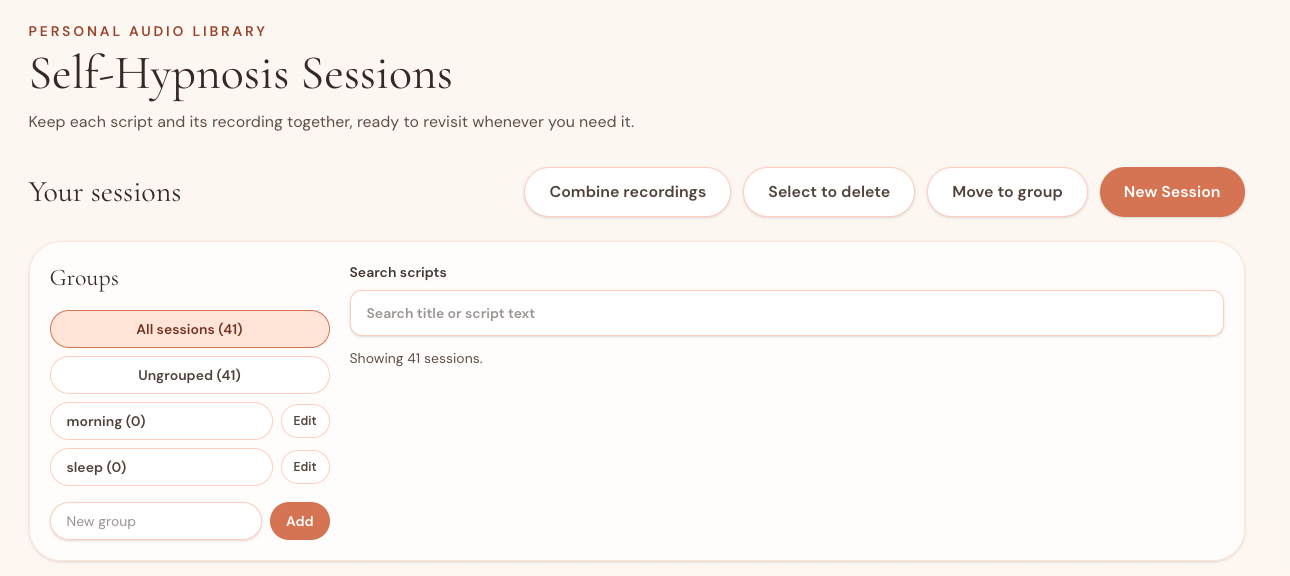
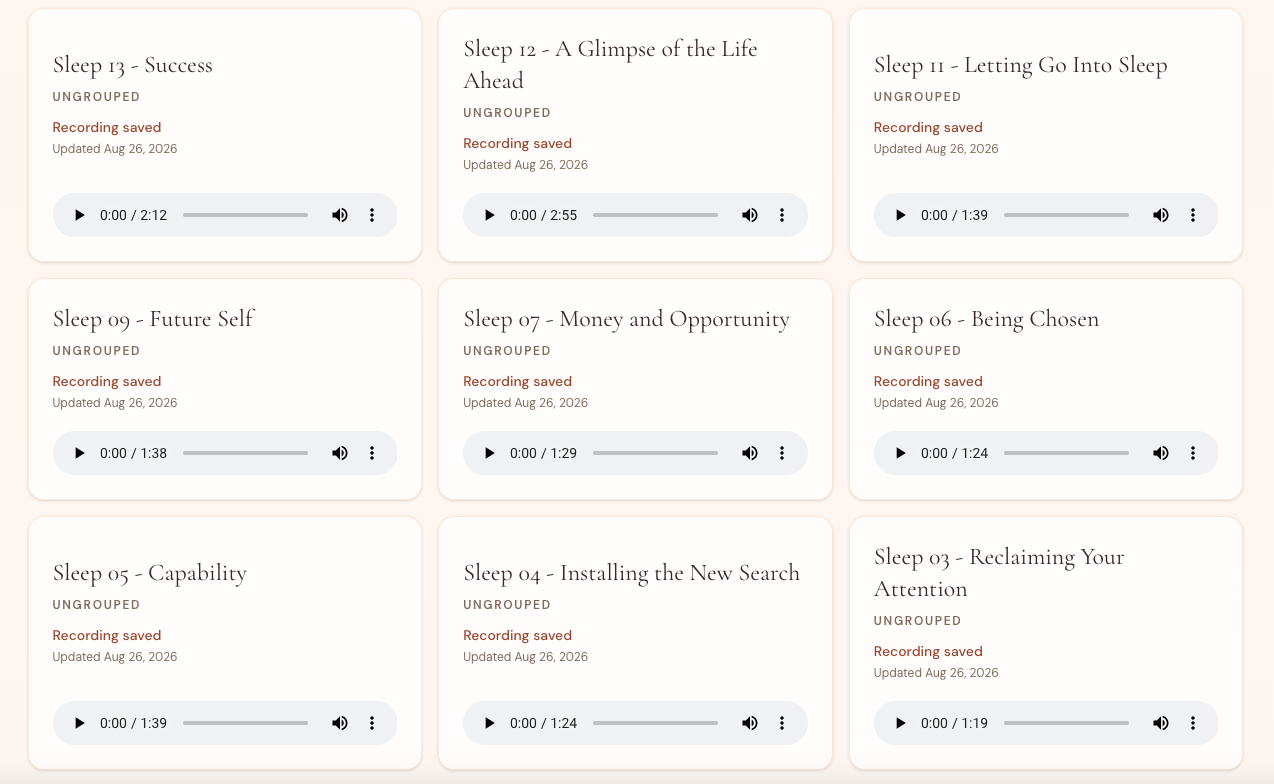
As the number of scripts grew, the problem changed. A single recorder was no longer enough; the product needed a library. Sessions gained titles, editable scripts, recording status, timestamps, and optional groups. Search spans both titles and script text, while filters make related sessions easier to revisit.
Write
Create a titled script and organize it into a meaningful group.
Record
Capture narration in the browser with clear microphone and recording states.
Review
Listen before committing, then save or discard and record again.
Compose
Choose recorded segments, arrange their order, and export one sequence.
I deliberately kept scripts and recordings as separate states. A session can remain “script only,” which means an unfinished idea is still valuable and does not have to become audio immediately.
Recording in the browser made iteration immediate
The recording flow uses the browser’s microphone APIs andMediaRecorder rather than sending the user to a separate audio application. The UI exposes the important states directly: ready, microphone active, recording ready to review, saving, saved, or unavailable.
A newly captured recording stays temporary until it is reviewed. The user can listen, discard it, or re-record before saving. That small distinction matters: capture is reversible, and an accidental take does not overwrite the saved version. Microphone tracks and temporary object URLs are also cleaned up when they are no longer needed.
Browser formats created the real engineering work
Browsers naturally record into formats such as WebM or MP4, depending on support. Those are practical capture formats, but MP3 and WAV are more convenient when a recording needs to move to another device or audio tool. I kept the original recording and added server-side conversion only when an export is requested.
The data model stores the relationship between a session and its audio metadata, while the file itself remains on disk. Replacing or deleting a recording removes the old file as well as updating the database. Download responses are marked as non-cacheable, and exported filenames are derived safely from the session title.
Composition was more interesting than a playlist
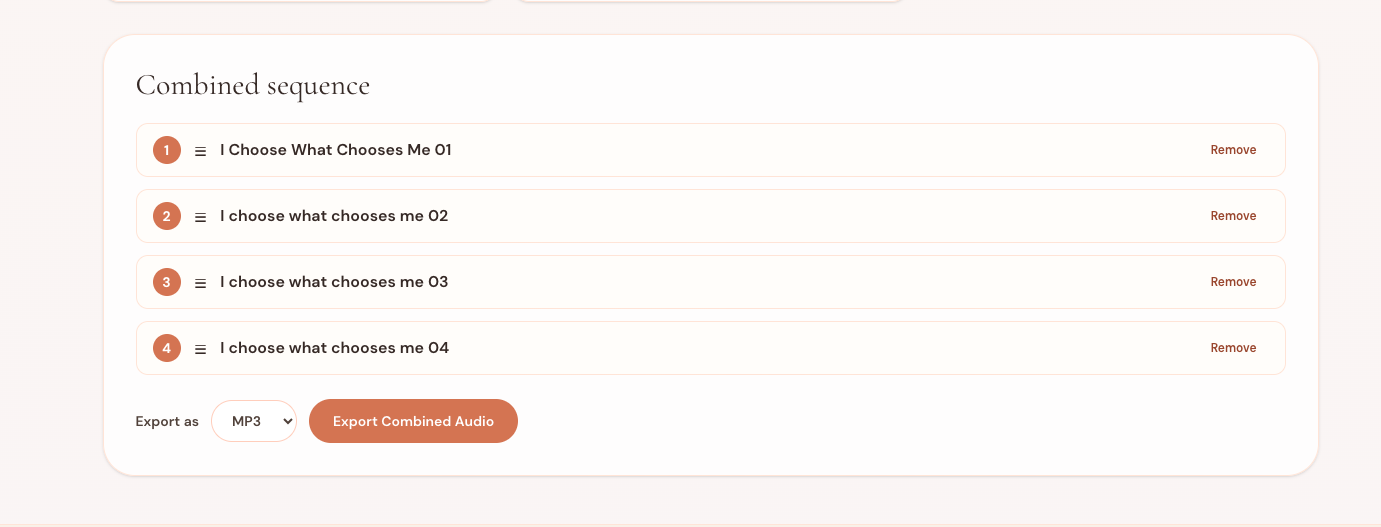
The most useful extension was the ability to combine recordings. A longer session can be assembled from smaller, independently editable segments. Recorded sessions are selected in order, rearranged with drag and drop, and exported as one MP3 or WAV file.
This changed the underlying mental model. Instead of treating a recording as one permanent monolith, the system treats it as a composable unit. An introduction, relaxation segment, focused script, and closing can evolve independently and be reused in different sequences.
Designing for calm still requires explicit feedback
A soft visual language should not make system state ambiguous. Recording controls have accessible names, unavailable actions are disabled, selection modes use both labels and visual indicators, and status messages explain whether the microphone is active or a save succeeded. Native audio controls provide a familiar playback baseline instead of a decorative custom player.
The library also separates destructive, grouping, and sequencing modes. That keeps a click on a session predictable and makes bulk operations explicit rather than hiding several behaviors inside the same card.
What I would explore next
- Add optional pauses and transitions between combined segments instead of joining every recording directly.
- Normalize loudness across recordings so a sequence feels continuous even when segments were captured on different days.
- Test microphone permissions, interruption recovery, and capture formats more deeply across mobile browsers.
- Introduce a storage abstraction and backup flow before treating the studio as anything beyond a private experiment.
- Explore script templates and timing cues while keeping authorship and final wording under the user’s control.
The most interesting part of the experiment was not recording audio. It was turning a private, fragile creative process into a workflow that remained editable, reversible, and reusable.Explore the Spiritual Peach case studySee the broader wellness platform, Peach Studio CMS, and branded content-generation workflow.